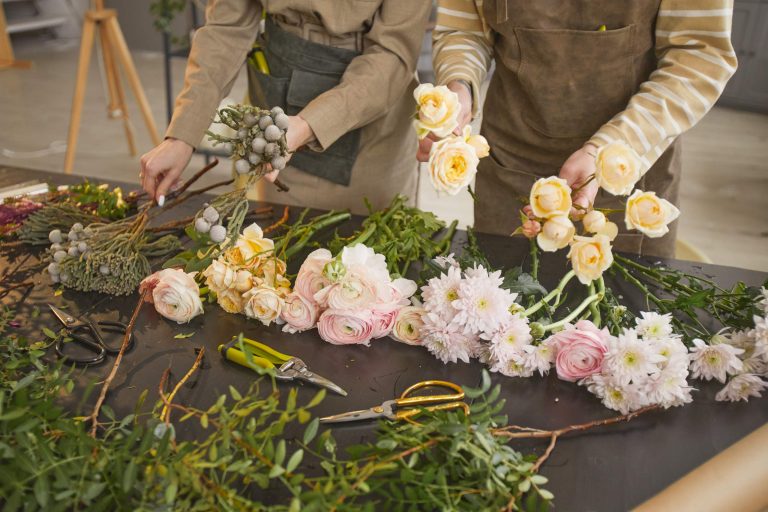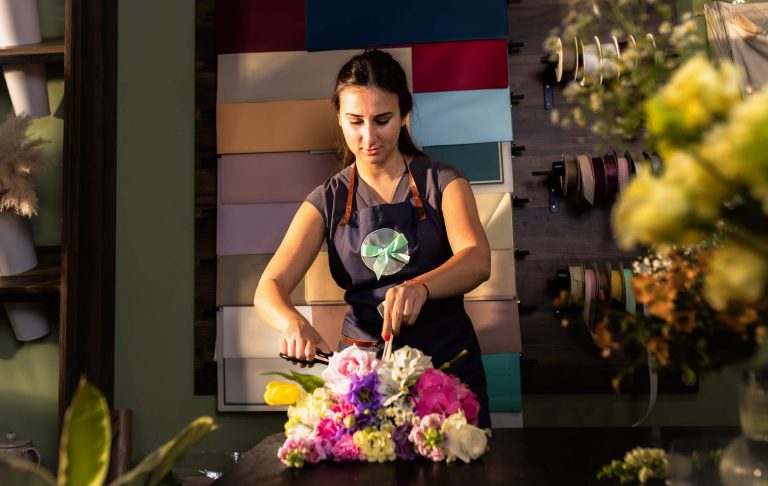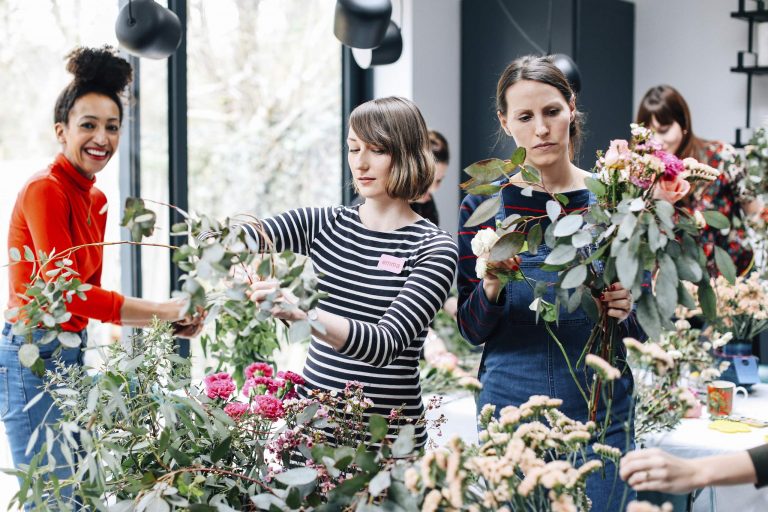
The best flower arrangements don’t happen accidentally. There’s a process for creating them that anyone can learn. As you work with flowers more and more, you’ll gain a feel for what works, but in the beginning it can help to know what to watch for.
Start by determining where your piece will be used, then decide on a mood. This will help you select flowers and other components. Once you’ve got a plan, the flowers will begin to feel like they belong together. They won’t be a random group of pretty flowers.
Think About Color
Color affects the mood a flower arrangement creates. Simple palettes work best. A couple of complementary colors work well, or you can have a neutral color punctuated by a strong contrast. Too many colors can become muddy and busy.
Check the Arrangement From Different Angles
It’s easy to get tunnel vision while arranging flowers. As you add stems and other elements, the piece will come together. Keep the big picture in mind, though.
Once the basic structure is in place, rotate the container so you can view the arrangement from different angles. Are there areas where the arrangement feels heavier? Crowded?
You want your arrangement to feel balanced, but that doesn’t mean symmetry. There shouldn’t be large open spaces on one side. It’s okay to have a heavier area; just make sure it doesn’t tip the composition out of balance.
Establish a Focus
There should be one or more elements of the piece that stand out over the others. This focal element will draw attention to your arrangement. Choose a dominant flower or group that becomes the focus of the composition. The main element need not be physically the biggest item. It can also be the most prominent from color, shape, or placement. The rest of the pieces should support the focus rather than try to take over.
Refine Before Finishing
As you build, take a step back periodically and ask yourself a few questions:
- Are the lines in balance? Look at the overall silhouette to see if one side seems to outweigh the others. You may find you have a heavy area. Adjust as necessary.
- Have you left enough negative space? An area of empty space allows a floral arrangement to breathe, draws attention to individual flowers, and can lend a lighter feeling. It’s common for beginners to fill in every empty space, but that’s not what happens with more sophisticated arrangements. Negative space is intentional.
- Have you used variation? Avoid too much repetition. Flowers vary in height naturally, so combine them to create interest and a sense of motion. This gives your arrangement a natural but controlled feel. The movement that comes from combining different growth habits will keep your arrangement from feeling flat or boring.
- Do you have enough texture and support? Grasses, branches, greens, and other fillers can add depth and unity to the arrangement. Don’t add them only because you have open spaces. Instead, let them be part of the arrangement from the start. Think of the supporting pieces as the structure that ties all the elements together. Smaller flowers work nicely here too.
Practice Builds Confidence
As you work with flowers and other components more and more, you’ll begin to develop a feel for what you like. You can learn design principles, but they’re not hard and fast rules. Try simple arrangements and work with one principle at a time. Once you’ve incorporated the elements and principles into your work, look at your arrangement with a critical eye. Remove any excess flowers. Consider the silhouette, negative space, and proportion one more time. With patience and practice, you’ll build confidence in your ability to arrange flowers with intention. Before you know it, you’ll develop a unique style.